Sub-millimeter Rotary Shear Clearing Plate Design
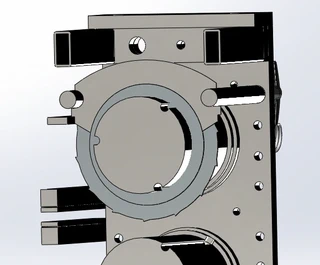
Overview
As part of my Bachelor of Science in Mechanical Engineering capstone at Washington State University, I led the mechanical design and FEA analysis for a novel clearing plate system that extended the operational life of Forest Concepts’ sub-millimeter rotary shear from 10-20 hours to significantly longer run times.
Sponsor: Forest Concepts
Team Members: Dean Kelley, Ian Aupperle, Forrest Fanara, Loren Bonner
Duration: Spring 2017
My Contribution: 128.5 hours
The Challenge
Forest Concepts partnered with Washington State University to develop efficient biofuel production from reclaimed biomass. Their rotary shear system could shred wood chips into sub-millimeter particles—critical for maximizing surface area in the chemical conversion process. However, the system had a fundamental flaw: small particles rapidly clogged the cutting device, causing frequent failures after just 10-20 hours of operation.
The existing clearing plates that removed material were ineffective, and the system faced three key problems:
- Rapid wear and failure - plates lasted only 10-20 hours
- Difficult replacement - time-consuming maintenance procedures
- Single-direction operation - inability to run cutters in reverse
Technical Approach
Material Selection & Analysis
My primary focus was developing the mechanical design and validating it through finite element analysis. The original clearing plates suffered from friction-induced wear where they contacted the blade bushings. I explored several solutions:
- Metal coating investigation - Researched electroplating options including Nye-Tef ($816 for 192 plates) and hard chrome ($1,142.40). Deemed too expensive.
- Alternative materials - Ran SolidWorks simulations comparing multiple steel alloys
- Final selection - Fully Hardened 1095 Spring Steel, selected for superior hardness and abrasion resistance based on Brinell hardness comparisons
Design Innovation
I produced several clearing plate designs and mounting configurations, ultimately contributing the final plate geometry that the team presented to Forest Concepts. Key design features included:
- Reversible double-sided plates - enabling bidirectional operation
- Improved mounting system - hitch-pin design (developed by teammate Forrest Fanara using my mounting location concept)
- 3D-printed C-clip spacers - reducing friction between plates and blades
- Enhanced durability - optimized geometry to handle stress loads
Simulation & Validation
After studying Forest Concepts’ initial simulation setup, I developed an improved FEA methodology:
- Created non-penetrating fixture systems for more accurate stress analysis
- Ran parametric studies with different materials to identify optimal performance
- Validated clearing plate designs under operational loading conditions
- Documented factor of safety, stress distributions, and deflection patterns
All designs were tested and validated using SolidWorks Simulation before prototype manufacturing.
Manufacturing & Prototyping
The team collaborated with DS&T to waterjet cut the first prototype clearing plate. I contributed to:
- Converting 3D CAD models to DXF format for waterjet cutting
- Part drawing creation and manufacturing specifications
- Material sourcing (team purchased 1095 steel sheets)
- Physical model assembly for presentation
Safety & Standards Compliance
The design incorporated OSHA safety standards:
- 29 CFR 1910.144 - Color-coding recommendations for operator safety around exposed cutters
- OSHA 1910.145 - Warning signage requirements for rotating machinery
- Contrast color selection between clearing plates and cutters to prevent operator injury
Challenges Overcome
Software compatibility issues - WSU’s SolidWorks (2016 SP2) was incompatible with Forest Concepts’ version (2016 SP5). I developed workarounds including remote desktop streaming and STL file conversions to maintain project momentum.
Design center Wi-Fi - Persistent connectivity issues in the senior design lab required flexible working arrangements and offline collaboration strategies.
Documentation - Learned the importance of concurrent documentation rather than retroactive reporting—a lesson I’ve carried throughout my career.
Results & Deliverables
- Extended operational life - clearing plates designed to significantly outlast the 10-20 hour baseline
- Functional prototype - waterjet-cut prototype validated design feasibility
- Complete technical package - CAD models, FEA results, manufacturing drawings, and safety documentation
- Professional presentation - delivered technical findings to sponsor and academic reviewers
Key Takeaways
This capstone project taught me essential engineering and professional skills:
- Cross-functional collaboration - coordinating with team members, sponsors, and external manufacturers
- Design for manufacturability - balancing performance requirements with production constraints
- FEA methodology - developing accurate simulation techniques for real-world validation
- Professional communication - presenting complex technical solutions to diverse stakeholders
The experience of moving from concept through analysis to physical prototype manufacturing solidified my understanding of the complete product development cycle—skills I continue to apply in my current role as a Sales Engineer supporting capital equipment projects.
Technical Skills Demonstrated
- SolidWorks CAD & Simulation (FEA)
- Material selection and mechanical properties analysis
- Stress analysis and factor of safety calculations
- Manufacturing process planning (waterjet cutting)
- Technical documentation and presentation
- OSHA safety standards application
For additional project details, see the complete project reports and timesheet documentation.
